COMING SOON!
OCTOBER 11
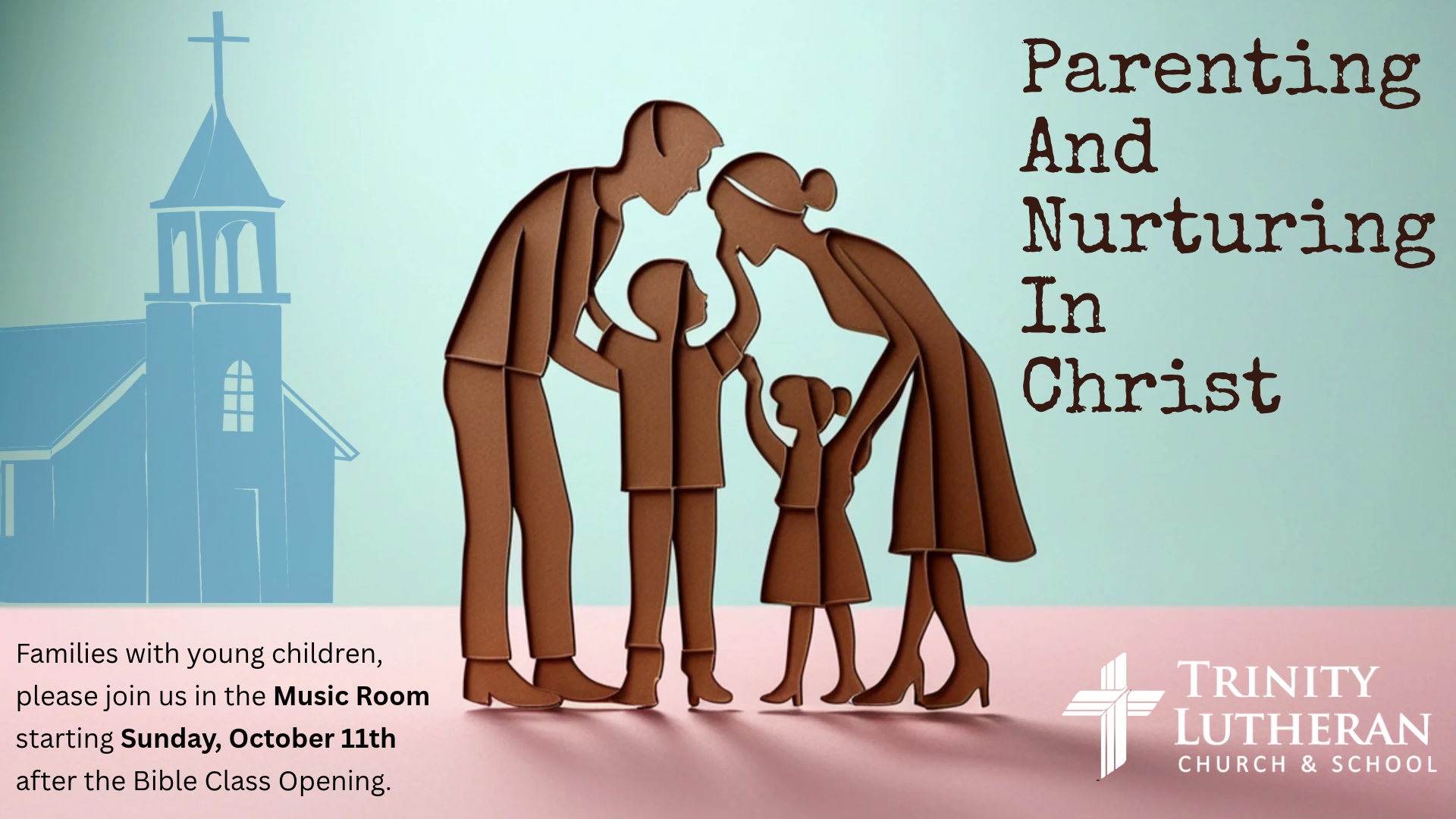
PANIC - Families with young children are invited to attend Parenting & Nurturing in Christ (PANIC), a welcoming space where moms and dads of little ones that aren't of Sunday School age yet gather for meaningful, Christ‑centered conversations while children enjoy play and fellowship nearby. Together, we explore real‑life topics about raising children in faith—celebrating the truth that parents don’t have to be perfect to make a lasting spiritual impact. As we share experiences and encourage one another, we strengthen our calling to teach the faith in our homes and help shape lifelong disciples of Jesus. Come be part of our Sunday mornings October 11th in the Music Room where faith is lived, values are practiced, and families grow together in Christ.
NOVEMBER 18
Family Fun Night - Watch for more info!
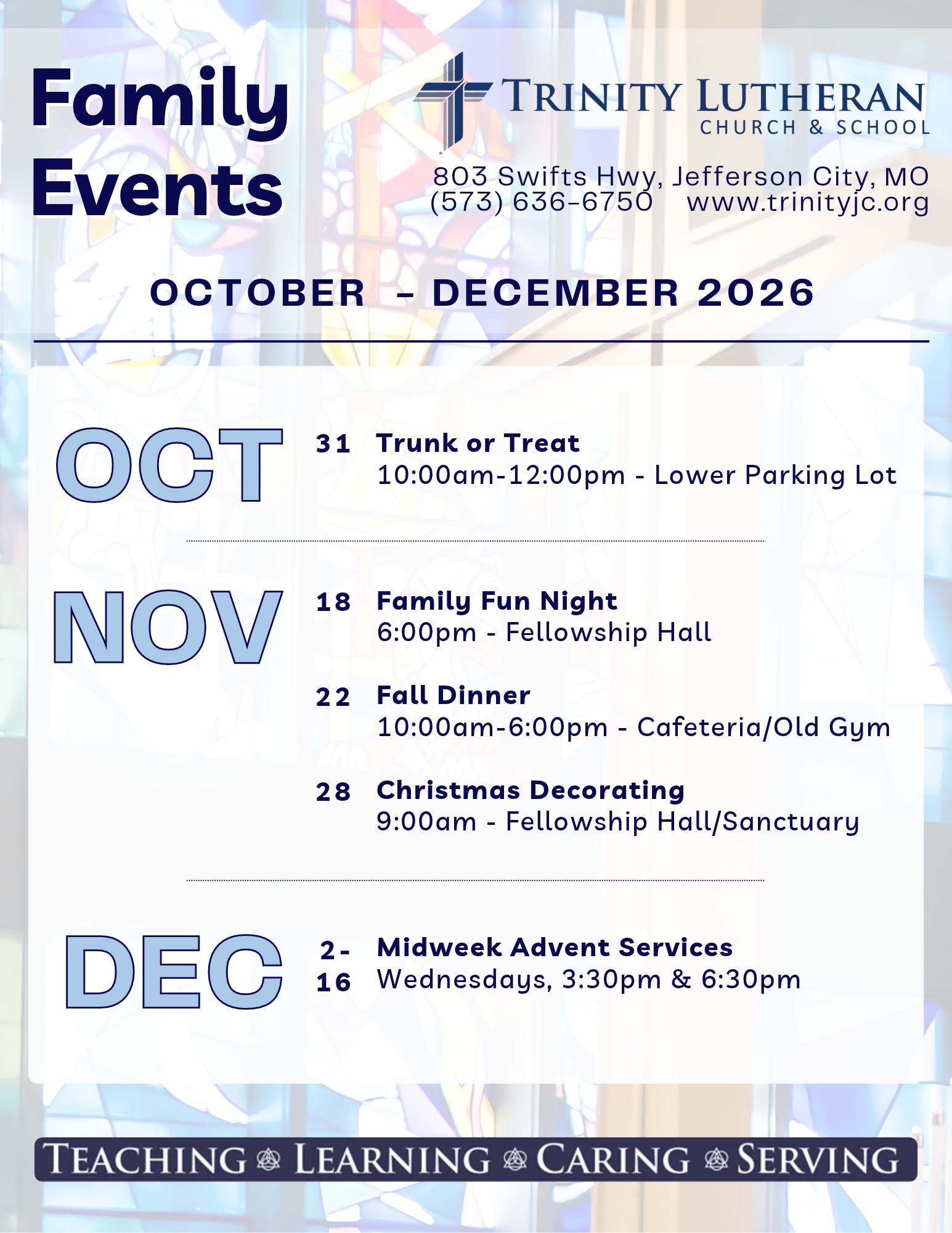
We invite you to learn a song with us each week! Our weekly hymn is chosen from the My First Hymnal, so even our youngest members can participate. The hymn is announced the news bulletin each Sunday and will be part of our worship service the following Sunday.
Not musically inclined? We have a YouTube playlist of all the hymns from My First Hymnal you can sing along with! See link below.
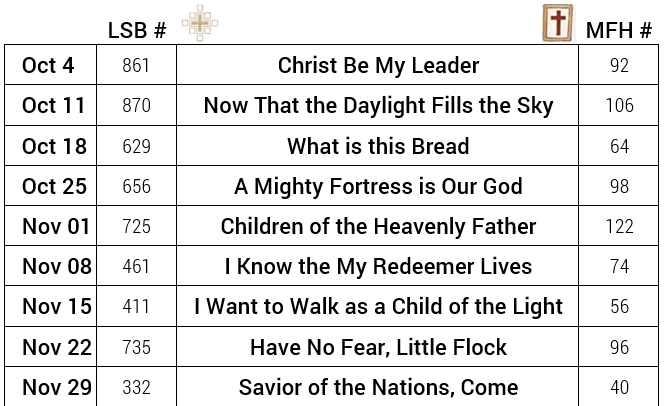
Family Resources
Learn the Ten Commandments with your family.
If you memorize two commandments each week, you will have all 10 commandments memorized just in time for Christmas!
WEEK OF NOVEMBER 15
The First Commandment
You shall have no other gods.
What does this mean? We should fear, love, and trust in God above all things.
The Second Commandment
You shall not misuse the name of the LORD your God.
What does this mean? We should fear and love God so that we do not curse, swear, use satanic arts, lie, or deceive by His name, but call upon it in every trouble, pray, praise, and give thanks.
WEEK OF NOVEMBER 22
The Third Commandment
Remember the Sabbath day by keeping it holy.
What does this mean? We should fear and love God so that we do not despise preaching and His Word, but hold it sacred and gladly hear and learn it.
The Fourth Commandment
Honor your father and your mother.
What does this mean? We should fear and love God so that we do not despise or anger our parents and other authorities, but honor them, serve and obey them, love and cherish them.
WEEK OF NOVEMBER 29
The Fifth Commandment
You shall not murder.
What does this mean? We should fear and love God so that we do not hurt or harm our neighbor in his body, but help and support him in every physical need.
The Sixth Commandment
You shall not commit adultery.
What does this mean? We should fear and love God so that we lead a sexually pure and decent life in what we say and do, and husband and wife love and honor each other.
WEEK OF DECEMBER 6
The Seventh Commandment
You shall not steal.
What does this mean? We should fear and love God so that we do not take our neighbor’s money or possessions, or get them in any dishonest way, but help him to improve and protect his possessions and income.
The Eighth Commandment
You shall not give false testimony against your neighbor.
What does this mean? We should fear and love God so that we do not tell lies about our neighbor, betray him, slander him, or hurt his reputation, but defend him, speak well of him, and explain everything in the kindest way.
WEEK OF DECEMBER 13
The Ninth Commandment
You shall not covet your neighbor’s house.
What does this mean? We should fear and love God so that we do not scheme to get our neighbor’s inheritance or house, or get it in a way which only appears right, but help and be of service to him in keeping it.
The Tenth Commandment
You shall not covet your neighbor’s wife, or his manservant or maidservant, his ox or donkey, or anything that belongs to your neighbor.
What does this mean? We should fear and love God so that we do not entice or force away our neighbor’s wife, workers, or animals, or turn them against him, but urge them to stay and do their duty.
Find all the commandments--and all parts of the Small Catechism--at https://catechism.cph.org.
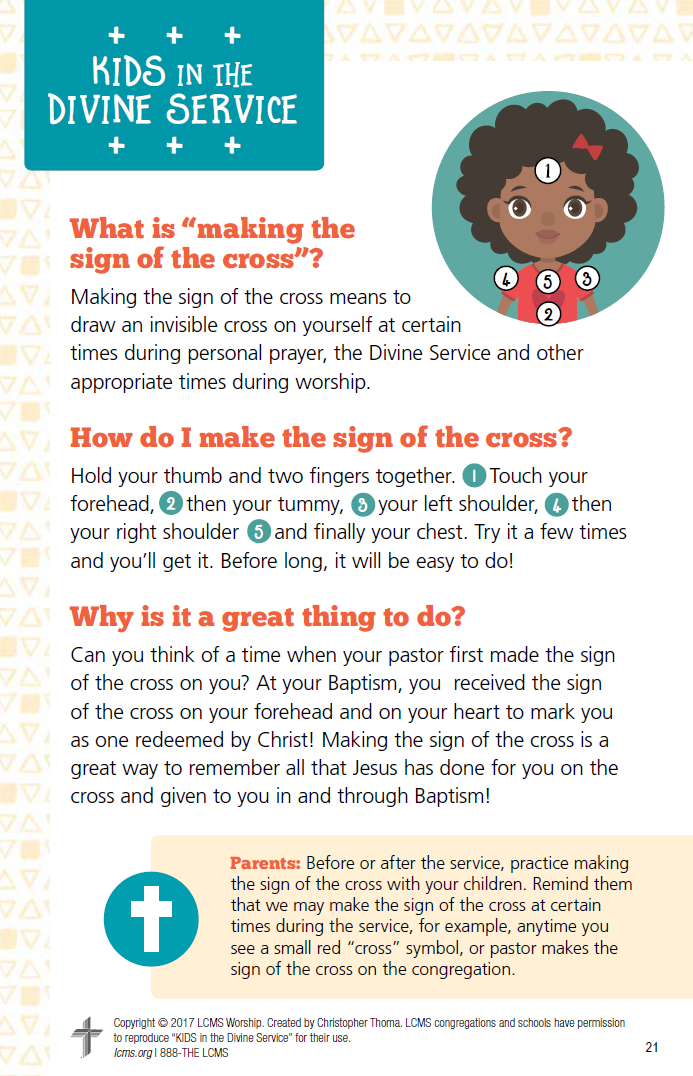
“It is the duty of every FATHER of a family to question and examine his children…”
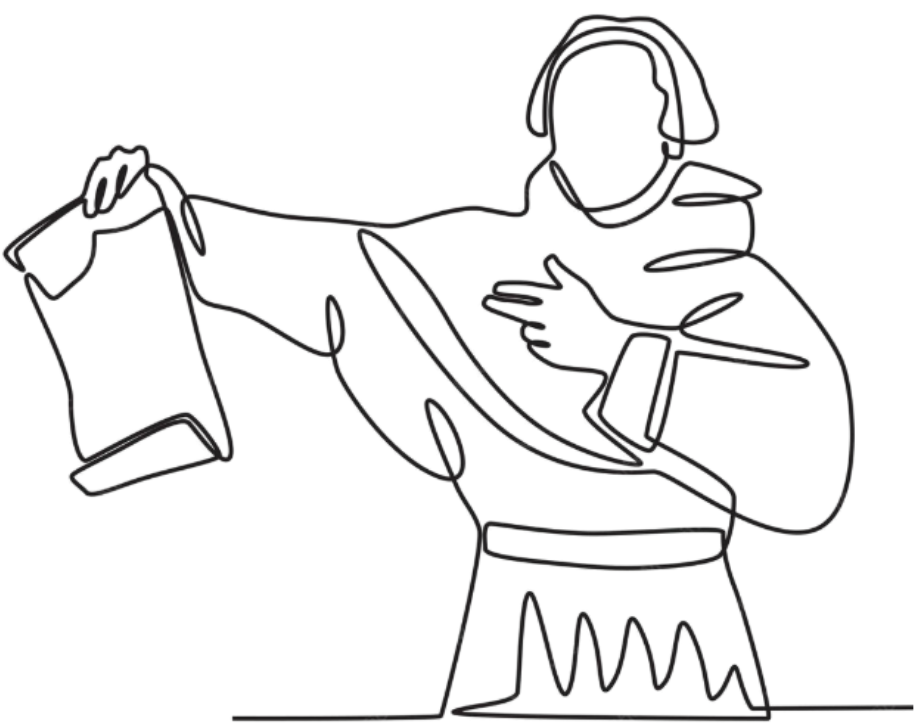
“In ancient times it was called in Greek CATECHISM (i.e., instruction for children). It teaches what every Christian must KNOW…, we must have the young learn well and fluently the parts of the catechism, diligently exercise themselves in them, and keep them busy with these parts. These parts are the following: God's TEN COMMANDMENTS, The Chief Articles of Our Faith (THE CREED), and THE PRAYER, or "Our Father," Which Christ Taught … These are the most necessary parts of Christian teaching that one should first learn to repeat word for word. And our children should be used to reciting them DAILY when they rise in the morning, when they sit down to their meals, and when they go to bed at night. . . In these three parts, everything that we have in the Scriptures is included in short, plain, and simple terms. For the holy fathers or apostles (whoever first taught these things) have summarized the doctrine, life, wisdom, and art of Christians this way.
Now, when these three parts are understood, a person must also know what to say about our Sacraments, which Christ Himself instituted: BAPTISM and the holy BODY and BLOOD of Christ. They should know the texts that Matthew [28:19–20], Mark [16:15–16], and St. Paul [1 Corinthians 11:23–26] wrote about the sacraments.
Then we would have all together five whole parts of Christian doctrine. These should be taught constantly and be required learning for children. You should hear them recited word for word. The young people should also be made to attend the preaching, especially during the time that is devoted to the catechism. . . For the reason we exercise such diligence in preaching the catechism often is so that it may be taught to our youth, not in a high and clever way, but briefly and with the greatest simplicity. In this way it will enter the mind easily and be fixed in the memory.”
Excerpts From "Short Preface of Dr. Martin Luther" in The Large Catechism, Concordia: The Lutheran Confessions, Pocket Edition. © 2005, 2006 Concordia Publishing House.
Source: https://bookofconcord.cph.org/en/large-catechism/short_preface_of_luther/
What are your priorities? “Thumbs Up for Jesus” means keeping Jesus as the first and foundational relationship so that His sacrificial, unconditional, and incarnational love flows through us into all our other relationships.
Imagine your hand held in a thumbs-up position. The thumb points upward toward Jesus, while the four fingers represent the other major relationships God has given us.
Jesus is not merely one priority among many. He is the source and foundation for all the others. When our relationship with Jesus is properly ordered, His love flows through us into our other relationships.
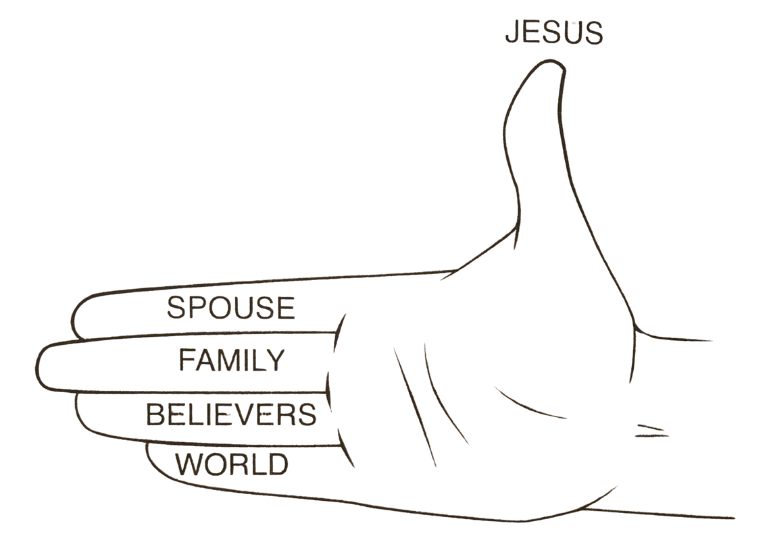
Jesus (the thumb): Jesus comes first. We receive His love, forgiveness, and life through His Word and the means of grace. Everything else flows from this relationship.
Spouse (first finger): For a married person, the marriage relationship receives the next level of priority. The marriage is characterized by sacrificial, unconditional, and incarnational love.
Family (second finger): Love and responsibility extend to children and the broader family. The idea isn't simply “spend more time with family,” but to see family relationships as vocations in which Christ's love is lived out.
Church (third finger): Christians are members of a spiritual family. Fellow believers aren't competitors or obstacles; they are brothers and sisters in Christ.
World (fourth finger): The love received from Jesus ultimately goes outward to people beyond the immediate Christian family. This includes one's vocation, community, neighbors, and witness to those who don't yet know Christ.
Thus the Christian life moves from Jesus → through our closest relationships → outward into the world.
from “Handing Out Life” by Rev. Todd Biermann
How do you start your day? Do you roll out of bed at the last minute and race chaotically into the deluge of life?
A better way is to orient yourself spiritually to anchor your day in the Lord's enduring promises. It changes the tone for the whole day and makes you better prepared to be a growing disciple of Jesus who is making disciples of Jesus wherever you go.
The good news is that it doesn't take much time to get your bearings set each morning. In fact, we've been sharing a simple practice that takes two minutes or less and is fitting for any disciple of any age.
SEE & HEAR Dr. Todd Biermann share a simple Daily Morning Orientation video.
When you're REALLY SHORT on time, use this Daily Essential Orientation video.
WORDING for the Essential Orientation:
- Where did I come from? From God, who made me.
- Where am I going? To God, who redeemed me when Jesus died on the cross and rose in victory.
- What's my purpose in between? To receive Jesus' sacrificial, unconditional and incarnational love and hand it out to everyone every day.
Resource from Concordia Center for the Family.
The Lutheran Church—Missouri Synod offers audio files from Lutheran Service Book so you may familiarize yourself with the liturgy. These recordings are ideal for pastors and church musicians learning to sing the parts of the service but may also be helpful for families practicing the liturgy at home with their children.
Richard Bicknase: Pianist, Organist, Composer, Hymnwriter, Hymn Lover, and LCMS Lutheran has created many playlists with most of the hymns from LSB as well as TLH that include lyrics, music, and vocals. This is a great way to practice some of your favorite hymns!
Concordia Center for the Family provides a page dedicated to resources produced or vetted by CCF or recommended by CCF. All are useful to promote Family Discipleship.
Note: There is a variety of free as well as paid resources.
Visual Family Ministry family resources connect children/grandchildren to the faith with downloadable activity pages.
-
Church
-
School
